

.png?width=854&height=484&name=unnamed%20(1).png)
In a world defined by radical disruption, the leaders who thrive aren’t the ones with all the answers; they are the ones with the best questions. We call this Agile Leadership. It’s the ability to pivot, unlearn, and reframe challenges in real-time. But curiosity isn’t just a fuzzy, "nice-to-have" personality trait. Thanks to the groundbreaking work of Dr. Todd Kashdan and his colleagues, we now understand that curiosity is a multidimensional tool—a psychological muscle that can be measured, trained, and deployed strategically.
Let’s explore the Five-Dimensional Curiosity Scale and how it can be a useful tool for any leader looking to strengthen their curiosity and agility skills to navigate the complexities of the 21st-century marketplace.
Why Curiosity is the Engine of Agility
Business leadership used to be about "command and control." You built a five-year plan and executed it with military precision. Today, a five-year plan is an artefact of the past before the ink even dries. To be agile, a leader must be open-minded and creatively resilient.
Curiosity allows us to see "signals" in the noise. It prevents the "Success Trap"—the dangerous tendency to keep doing what worked yesterday while the world moves on. By measuring and understanding the five dimensions of curiosity, we can identify our blind spots and become more effective at leading diverse teams through "white-water" change.
The following are five dimensions of curiosity:
1. Joyous Exploration
This is the "classic" form of curiosity. It’s the sheer pleasure of seeking out new information and experiences. For a leader, this is the drive to understand how a new technology works, or why a competitor in a completely different industry is succeeding.
- In Business: It fuels innovation and R&D. Leaders high in Joyous Exploration don’t just "do" their jobs; they are fascinated by the ecosystem they inhabit. They find joy in the "why."
- The Application: It’s what leads a CEO to look at a shipping company’s logistics to solve a digital streaming bottleneck.
How to Improve Your Score:
- Cross-Pollinate: Spend one hour a week reading or listening to content completely outside your industry (e.g., if you’re in Fintech, read about Marine Biology). Look for patterns that apply to your world.
- The "Beginner’s Mind" Exercise: Once a month, shadow a junior employee in a different department. Ask questions as if you know nothing about their role.
2. Social Curiosity
Social curiosity is the desire to understand what makes people tick. It’s not about gossiping; it’s about deep empathy and interest in the perspectives, experiences, and intentions of others.
- In Business: This is the bedrock of high-performing cultures. A socially curious leader listens more than they talk. They want to know why a team member is demotivated or what a customer actually feels, beyond what the data says.
- The Application: This dimension is critical for managing diversity and inclusion. It allows you to bridge gaps between different cultural or professional backgrounds.
How to Improve Your Score:
- Active Listening Audits: In your next one-on-one, challenge yourself to ask three "Why" or "How" questions for every one statement you make. Focus entirely on the other person’s logic.
- Perspective-Taking: When you disagree with a stakeholder, stop and write down three valid reasons why they might hold that position. Seek to understand their "truth."
3. Deprivation Sensitivity
This is the "itch" you need to scratch. Unlike the "joy" of exploration, this is a more intense, sometimes anxious drive to close a gap in knowledge. It’s the persistence to stay up late solving a complex problem because not knowing the answer is frustrating.
- In Business: This is the grit behind problem-solving. Leaders with high deprivation sensitivity are the ones who dig into the "messy" data to find the root cause of a falling retention rate.
- The Application: It ensures accuracy and thoroughness. It prevents leaders from accepting superficial explanations for complex failures.
How to Improve Your Score:
- The "Five Whys" Technique: When faced with a problem, don't stop at the first answer. Ask "Why?" five times to get to the foundational issue.
- Deep Work Sprints: Set aside 90-minute blocks of "no-distraction" time to tackle a single, complex problem that you’ve been avoiding. Embrace the frustration—it’s a sign of growth.
4. Thrill Seeking
Thrill seeking involves the willingness to take physical, social, or financial risks to experience something new and complex. It’s about the appetite for the unknown.
- In Business: Agile leadership requires a high tolerance for calculated risk. Whether it’s pivoting a business model or entering a new geographic market, you must be willing to step off the ledge.
- The Application: It prevents "Analysis Paralysis." Thrill-seeking leaders are comfortable with 70% certainty rather than waiting for 100%, allowing them to move faster than the competition.
How to Improve Your Score:
- Micro-Risks: Start small. Speak up in a meeting where you’d normally stay silent, or pitch an "out there" idea. Get comfortable with the rush of being vulnerable.
- The "Post-Mortem" Reframe: View failures as "tuition fees." By reframing risk as a learning experiment, the "threat" becomes a "thrill" of discovery.
5. Stress Tolerance
This is perhaps the most critical dimension for leaders in a crisis. It is the ability to remain curious and open-minded even when faced with high-stress, anxiety-inducing situations. When things go wrong, do you shut down (defensive) or do you wonder "What can we learn here?" (curious).
- In Business: It’s the difference between a leader who panics during a market crash and one who calmly looks for the new opportunities the crash creates.
- The Application: High stress tolerance allows for "Cognitive Flexibility." It keeps your prefrontal cortex online when your lizard brain wants to fight or flee.
How to Improve Your Score:
- Mindfulness and Labelling: When you feel stress rising, mentally label it: "I am feeling tension." By naming the emotion, you create distance from it, allowing your curious mind to take over.
- Scenario Planning: Regularly practice "Pre-Mortems." Imagine a project has failed and ask, "How did this happen?" Practising for the worst-case scenario reduces the shock when real stress hits.
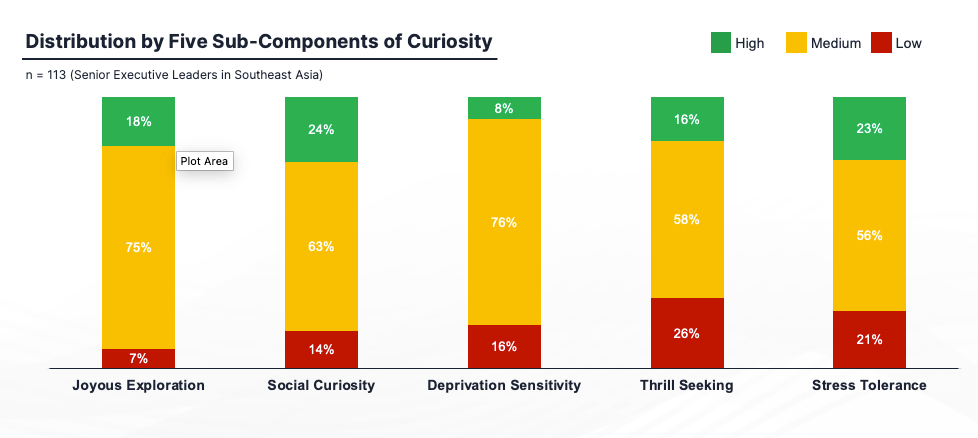
The Synthesis: Leading with the Full Scale
As leaders, we often lean heavily on one or two of these dimensions. Perhaps you are a great "Thrill Seeker" but lack "Social Curiosity," leading you to take risks that your team doesn’t support. Or maybe you have high "Deprivation Sensitivity" but low "Stress Tolerance," meaning you get bogged down in details and freeze when the pressure is on.
The goal isn't necessarily to be a "10 out of 10" in every dimension, but to be aware of your profile. In my journey with AirAsia X, "Thrill Seeking" and "Stress Tolerance" were my daily bread. But as I moved into the digital health space with Naluri, "Social Curiosity" and "Joyous Exploration" became the primary drivers for understanding employee behavior and psychological outcomes.
Conclusion
In the age of AI and hyper-competition, your technical skills have a shelf life. Your curiosity does not. By embracing the Five-Dimensional Curiosity Scale, you aren't just becoming a better manager; you are becoming an Agile Leader—someone who is energized by change, connected to their people, and perpetually ready for the next frontier.
The next time you face a daunting business challenge, don’t reach for your old playbook. Instead, ask yourself: Which dimension of curiosity do I need to activate right now?
To find out more about these five components of curiosity, click on this link.
Stay hungry. Stay curious.
* * *
To learn more about applying curiosity to strengthen your leadership, do reach out to Naluri’s career and workplace executive coaches or Naluri’s psychologists and counselors via the Naluri app or web.naluri.life